Sunday, February 6, 2011

Greetings from the Top of Europe

Seat (that's the Manufacturer) Minivan
Eight of us sat down on Friday night to try to hammer out a plan to go skiing in France on Saturday.  Admittedly, it was poor foresight and planning and it really could have come back to bite us as far as cost went.  But we looked at different buses and shuttles, and the best price we could find was 50 euro round trip (which is about $75) each.  Someone then suggested we rent a car, and after only a few minutes of research, we found a rental company at the airport that had a few minivans available, so we chose the Seat for 167 Swiss Francs (about $180 US), that had a 1.4 litre 4-cylinder motor, a manual transmission, and unlimited mileage included.  After gas, parking, and the price of rental, each person in the group only had to pay 25 Swiss Francs, so it worked out extremely well.
Driving, Alps in the distance

I will admit, being able to drive in Europe was a lot of fun for me.  I love driving anyway, but being able to try to figure out road markers and roundabouts while having the Alps in the backdrop was a blast.  The drive to Chamonix only took about an hour each way, and the last 45 minutes of the drive was in France (my first time in that country).  Chamonix is a well developed town nestled in a valley directly underneath the largest peak in Western Europe, Monte Blanc.  Everything was dwarfed by the mountains surrounding the town.  We got to the ski rental place, which was a very different experience than going to a ski resort on the East Coast of the US.  This was a quaint shop with eight seats that each had its own fur pelt for us to sit on, and a single man carefully selecting which skis to provide us with and adjusting the bindings accordingly.  It was very unlike the mass operations that you find on the East Coast of the US.  We paid, got on a bus, and got on the gondola that took us up to something of a base-camp, where you catch the lifts up to the slopes.  This gondola had to have taken us up at least 5,000 to 6,000 feet of elevation, considering the mountains we were skiing on were all around 10,000-12,000 feet.    I decided to stick with the intermediate to advanced members of the group, which I quickly regretted.

We got on a lift and got up top, and I came to the immediate realization that a Red-slope on the East Coast of the US is not a Red-slope in the Alps.  There were drops like I have never seen that I would have to try to navigate my way down, otherwise I would be stuck on the mountain, or be that poor sap riding the lift back down.  Naturally my pride took over and I went for it.  There were moments that I felt like a skiing God, but I do mean moments.  These few, sometimes up to 10 seconds, I was cutting left and right and feeling like I could handle anything.  Then inevitably, I would get going to fast, lose control, and eat it.  And I ate it hard.  Several times.  There were times where I had to hike 150 feet back up a 45-degree hill to retrieve my skis because I slid so far when I had fallen.  When you walk up an incline like that, you need to dig your toes into the snow carefully with each step, otherwise you slip and you slide some more.  It takes a lot to thoroughly frustrate me, but this did it.  I was as close to miserable as I have been in a long time.  Each time I fell though, I just looked around and reminded myself where I was.  I was cut, sprained, bruised, wet, beaten, and demoralized, but I was attempting my way down one of the largest mountain ranges in the world on skis, and that is something that not everyone has the opportunity to try.

Britt, Hannah, and I made our way across the mountain, heading towards the rest of our group, who wisely stuck to the green slopes for most of the day.  By 2:30, we had rendezvoused with them and I found myself in much more comfortable territory, only falling once in my last 5 runs of the day.  I wish I had started out my day there to build confidence and get my skiing legs under me before attempting anything bigger, but I was definitely happy to end there on a good note.

We took the gondola down into town, and hustled back to the ski shop to get the now painfully uncomfortable ski boots off, and met up with the rest of the group.  We then got in the car and drove back to Geneva, winding down from a long, rewarding day.

I cannot overstate the beauty of these mountains.  I have been to the Rockies once in the summer, and I remember being awestruck by them.  But the Alps are bigger, more jagged, and more massive.  I am thrilled that I got to experience them.

Road to Chamonix

Chamonix

Gondola up to where we catch the Ski lifts
View from the top of the Gondola


View from the top of the Gondola


Chamonix

Chamonix

Sunday, January 30, 2011

Lausanne: Part 2

Hotel D'Ouchy
Wooden Boat


Lausanne - Ouchy Marina

Lausanne - Ouchy Marina


Adrianne
Lausanne - Ouchy Marina


Hotel D'Ouchy

Lausanne
Palace of Justice


Cathedral overlooking the city
Library
Library


Cathedral
Adrianne outside the Cathedral
Sunset over Lake Geneva


Alps in the Distance

Sunset over Lake Geneva

Thursday, January 27, 2011

Week 3.5 Update

For the past week and a half, I have been getting more involved in both my school work and my work for the Geneva International Centre for Humanitarian Demining, so I have not had as much time to explore as I would like.  This Saturday a group of 10 of us will be taking an early morning train to Lausanne to further explore that town, and go out at night there for a few hours until our return trip at 1:30am.  We got the tickets for 21 Swiss Francs (about $21) round trip, which is half the normal price so we are all very excited about that trip.  There was a consensus amongst some people that getting out of Geneva was a must for this weekend, and in fact, most of our group will be gone all weekend.  The extended exploration of Europe is beginning!

This semester in school, I am taking 9 credit-hours of classes, and receiving another 3 credit-hours for my internship.  The classes I am taking are European Politics, Problems with International Organizations, and International Trade.  Those first two classes are taught by Dr. Suzanne Peters, who is a German-national, married to a Spanish man (because, according to her, German men are awful), living in Geneva.  Before Switzerland, she and her family lived in France for several years.  Her father fought in the German Wehrmacht in World War II on the Eastern front against the Russians, and after the war when she was just two years old, her family illegally immigrated from East to West Berlin before the construction of the Berlin Wall.  She told the story of how her family all rode on the same train but she was sitting with her mother, and her father and two siblings were sitting farther back in the train in another car to eliminate suspicion of the Secret Service employees that monitored the travel documents of the passengers.  When the woman came to check her mother's travel documents, young Suzanne, being excited and overly talkative, remarked "and my Father and two brothers [or sisters, I can't remember] are further back on the train!"  While her Mother's heart-beat skyrocketed, the Woman checking their documents ignored the annoying child.  Her experience growing up in post-War Germany has given her interesting perspective on European politics.  So far we have had three classes, and all we have covered is German pre-War history and WWII history.  The reason for this is because she believes that everything that happens in European politics is directly related to World War II, its origins, and aftermath.  I thoroughly enjoy my other classes too, and I'll give updates on those periodically throughout the semester also.

Work has been great so far.  Let me explain my NGO as briefly as I can:
In the mid-1990s, several States came together to sign the Ottawa Convention (or the Anti-Personnel Mine Ban Convention, APMBC), which was an international agreement to combat landmines.  All States that signed agreed to destroy their current stockpiles, not transfer anymore mines, not build anymore mines, remove any mines that have been emplaced on their territories, and assist any other States that have signed on that do not have the means to complete these tasks.  There are time lines for these tasks, and to help States complete them, the Convention called for the formation of the Geneva International Centre for Humanitarian Demining (GICHD).  This Non-Governmental Organization (NGO) has several departments, including Operations, Communicationsmy department, the Implementation Support Unit (ISU).  The ISU's jobs include keeping up the Documentation Centre for the GICHD, organizing the yearly Meeting of States' Parties and other conferences, and getting countries the help that they need in order to fulfill their requirements to the Convention.  Not so brief an explanation, I know.  But my official job title is Intern for the APMBC ISU.  So far, they have set me free on the Documentation Centre, organizing documents into logical categories and cataloging it all into a bibliography.

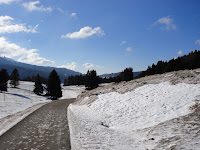
On Friday, the GICHD took us for a team-building day in a remote area outside of Lausanne called La Givrine.  We arrived at about 10:30am and immediately started a 5 kilometer hike on the coldest/most windy day that this area has seen all winter (around 25 degrees Fahrenheit).  By the time we arrived at our destination, we were chilled to the bone.  Our destination was a building that is owned by the State, but is rented out all year long.  For the 6 warmer months, it serves as a farm-house, and in the colder months it is rented out to a family who operate a restaurant for the cross-country skiers, hikers, and snow-shoers who frequent the beautiful forests in the area.  The dining area was no bigger than 20' x 20' with an open fire pit on one side that provided the warmth for the room and heated the water for the whole facility.  We were greeted at our tables with bottles of local wine to warm us, fresh slices of bread, and plates of thinly sliced, dried and salted beef which was one of the tastiest applications of beef I have ever eaten.  We talked as we made our way through the appetizers and a few glasses of wine, and finally our fondue arrived.  It was in a beautiful pot and consisted of local wine and cheese.  I knew the Swiss take fondue seriously, but I had no idea of the extent.  There is a whole ettiquette behind it.  You're not supposed to just dip, you're supposed to submerge and stir, in order to keep it from separating.  There is a very strong liquor called Kirsch which you order in a shot glass and slightly dip your bread in before even putting it into the cheese.  Finally, when you're down to the last centimeter or so in the pot, you let it cook and almost burn to the bottom, at which point the server will scrape it for you and you snack on the crispy cheese.  It was a true cultural experience.  There were no health inspection certificates and our servers were the two sons and the wife of the gentleman who was cooking for us and they were wearing their street clothes.  The chef wore a flannel shirt and came out to chat with us on several occasions during the meal.  It was informal home cooking and I loved it.  Finally, when we were filled with bread and cheese and buzzed from the wine and Kirsch, we took our hike back down the path and headed back to Geneva.

I'm excited to get out to Lausanne again this weekend, and I'm sure I will have more to report on then!
La Givrine
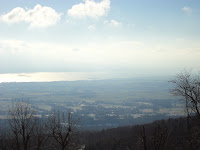
Overlook of Lake Geneva

La Givrine Hike

Open pit fire, water-heater on the right

Huge Cowbells

Farmhouse/Restaurant

La Givrine


Part of the group


Camera lens fogging from change in temp.

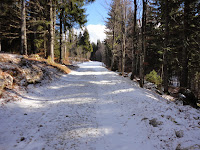
Walk down

Walk down

Sunday, January 16, 2011

Le Chef-d'œuvre (Masterpiece)

L'orgue
      I wish that I had knowledge of classical music.  I know some basics, and I have always loved listening to classical music, but I've never studied it and I certainly cannot place a song that I hear in its classical period. Some of that knowledge would have come in use today, because I would love to be able to identify the closing piece that was played at the St. Pierre Cathedral this morning.  The other knowledge that may have helped would be in the French language, because then I could have at least asked somebody.
      It started out with several measures of fast and high notes that seemed to lift the vaulted ceilings of the Cathedral straight off of their walls.  It was very beautiful and delicate, almost like listening to a harp.  And then the bass line kicked in.  The low pipes on this organ are bigger around than I am, and when they blast, the bass reverberates through the thick stone walls and you can feel it coarse through your entire body.  The sheer contrast of the delicacy of the high notes and the raw power of the lows was awe-inspiring.  Nobody moved from their seats or grew restless, despite the fact that the service had ended.  It was breathtaking.  The organist did his work for at least ten or twelve remarkable minutes, before ending with a ten-second long major-chord that brought tears down my face.  Awe-inspiring.
      I'd love to know the song, but I don't think that any sound system I'd be able to play it on would do it justice.  I will go back next week to see if they can play me another masterpiece.

Wednesday, January 12, 2011

Geneva at Night

Most people who know me well know that I am not a city person.  I feel much more at home in a smaller mid-west or southern town than I ever have in a city, with the exception of maybe Pittsburgh.  But I will be the first to testify that there is something about cities at night.  The strange mix of sensations that runs through one's body and mind can pull your emotions in different directions.  The streets are silent but the occasional car acts as a passing reminder that, in just a few hours' time, they will be busy.  There is a lingering feeling of threat, knowing that most crimes that are committed are committed at night.  But above all, there is the feeling of absolute solitude in an environment that does not usually facilitate anything resembling solitude.  Cities at night make me feel alive, and Geneva is no different.

I woke up tonight at midnight after two hours of restless sleep, caused by my aching wisdom teeth.  As I went downstairs to find something that would help to numb the pain, people began to filter in from their night out at the bar.  One member of the group, after thinking about her friend serving in the military overseas all night, was very distraught and, seeing as I was not getting to bed anytime soon either, we decided to go for a walk.  I came upstairs, threw on my jeans, shoes, and a jacket, and met her outside.  As we walked along the Rhone, we chatted about her friend, her pride in his service to our country, and the politics behind her beliefs.  Normally such a contentious topic, it seems, but I was thrilled to talk with someone who shares many of the same principles, as well as contradictions.  In all, we were out and about for an hour or so, and had wonderful conversation the whole time.  When we came home, I made some tea, grabbed some ice cream, and went back to bed. 

The teeth are still hurting a bit, but I'll be able to sleep through it.  The cold air got my blood pumping again.  Life is good.  Tomorrow is my first full day at the Implementation Support Unit (ISU) for the Anti-Personnel Mine Ban Convention in the Geneva International Center for Humanitarian De-mining (I'm still working on spitting that job title out smoothly), and I am ready to start getting some work done.

Sunday, January 9, 2011

Further Geneva Explorations

St. Pierre Cathedral, Geneva
Wrong aperture, heavenly effect

St. Pierre Cathedral, Geneva

Organ at St. Pierre Cathedral

John Calvin's Chair
Alexis next to the hobbit door

Ginko tree

Geneva's Jet d'Eau
Jet d'Eau
Jet d'Eau

Jet d'Eau
Spray from the Jet d'Eau

My side of Geneva, from across the Rhone